
By Dr. Anil Siddharth Tambe
Pediatric Gastroenterologist & Hepatologist | Mumbai
World Hepatitis Day is observed every year on 28 July to raise awareness about viral hepatitis and its impact on liver health. The World Health Organization’s 2026 theme, “Hepatitis: Let’s break it down,” focuses on reducing barriers to prevention, testing, treatment, and care.
For parents, this message is especially important because hepatitis and jaundice in children are often misunderstood, delayed, or assumed to be routine illnesses. (World Health Organization)
In children, hepatitis usually means inflammation of the liver. This may happen because of viral infections such as Hepatitis A, B, C, or E, but liver inflammation can also occur due to certain medicines, metabolic conditions, autoimmune liver disease, or severe infections affecting the body.
Many children recover completely, especially from uncomplicated viral hepatitis. However, some children may need careful monitoring, blood tests, specialist evaluation, or even urgent care if the liver is significantly affected.
The key message this World Hepatitis Day is simple:
👉 Not every jaundice in a child is “simple hepatitis.”
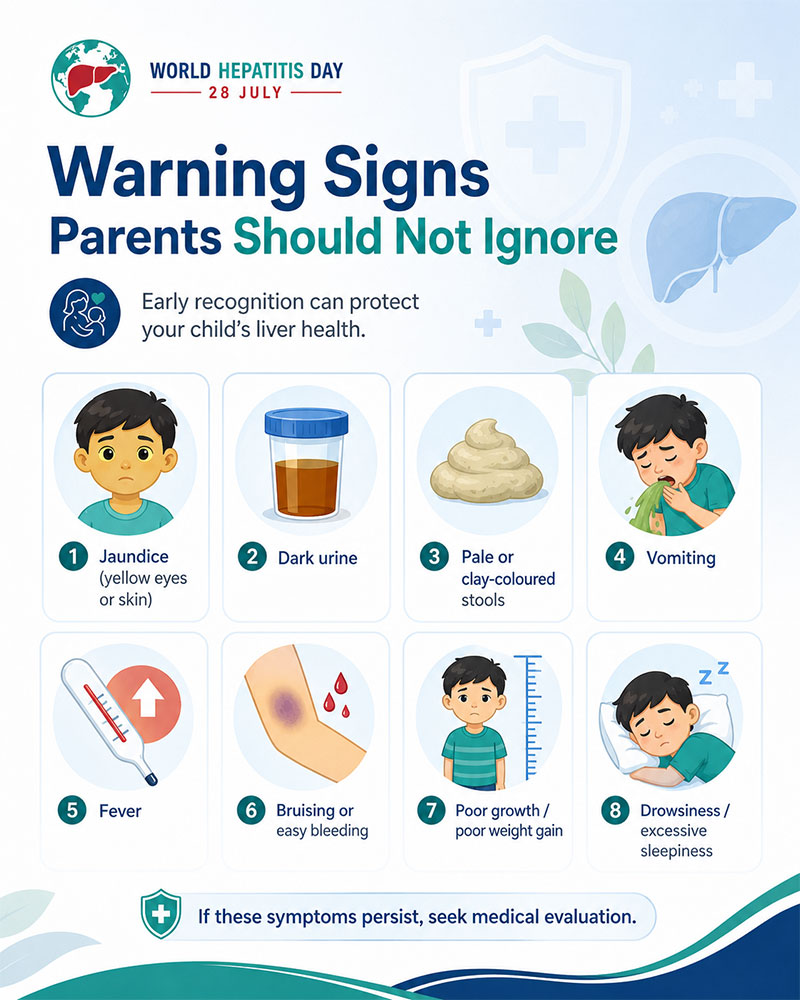
Persistent jaundice, dark urine, pale stools, bleeding, drowsiness, poor growth, or abnormal liver tests should never be ignored.
The liver is one of the most important organs in a child’s body. It helps digest food, stores energy, processes nutrients, fights infections, produces important proteins, helps blood clot properly, and removes toxins from the body.
Because the liver performs so many essential functions, liver disease in children can present in many different ways.
Some children may develop yellow eyes or skin. Others may have poor appetite, vomiting, abdominal pain, poor weight gain, swelling of the abdomen, easy bruising, or unusual tiredness.
In babies, the clues may be even more subtle:
Hepatitis means inflammation of the liver. In children, the most commonly discussed types are viral hepatitis infections.
Hepatitis A usually spreads through contaminated food or water, or through close contact with an infected person. It is closely linked with unsafe water, poor sanitation, and inadequate hand hygiene.
Symptoms may include fever, nausea, vomiting, abdominal discomfort, poor appetite, dark urine, and jaundice.
Most children recover well, but rarely Hepatitis A can lead to severe liver injury or acute liver failure.
WHO notes that Hepatitis A does not cause chronic liver disease, but it can cause mild to severe illness and, rarely, fulminant hepatitis. (World Health Organization)
This is particularly relevant in India during the monsoon season, when food and water contamination may increase the risk of gastrointestinal infections, including infections that affect the liver.
Hepatitis B is important because it can become chronic, especially when infection occurs early in life.
It can spread from mother to baby during delivery, through infected blood or body fluids, unsafe injections, unscreened blood products, or sharing personal items that may have microscopic blood contamination.
The good news is that Hepatitis B is vaccine-preventable.
In India's Universal Immunization Programme, Hepatitis B birth dose is included at birth, and the schedule specifies that it should be given at birth or as early as possible within 24 hours.
Hepatitis C is less common in children than Hepatitis A or B, but it remains important.
It spreads mainly through infected blood.
There is currently no vaccine for Hepatitis C, but effective treatments are available, especially in older children and adults depending on age and clinical context.
CDC notes that Hepatitis C may become chronic in many infected individuals and can lead to liver disease over time. (CDC)
Hepatitis E is also transmitted through contaminated water and is relevant in many parts of Asia.
It usually causes an acute illness, but it can be serious in certain high-risk groups.
In children, it should be considered when jaundice occurs after a febrile illness or gastrointestinal symptoms, especially if there is a history of unsafe water exposure.
No.
This is one of the most important messages for parents.
Jaundice means yellow discoloration of the eyes or skin due to increased bilirubin. Hepatitis is only one of the possible causes of jaundice.
Children may develop jaundice due to:
In babies, jaundice is common in the first few days of life. However, jaundice that persists beyond the expected period should be evaluated carefully, especially if there is dark urine or pale stools. Joint NASPGHAN/ESPGHAN guidance recommends evaluation for cholestasis with total and direct bilirubin measurement in any infant who remains jaundiced after 2 weeks of age, with timely referral if direct bilirubin is elevated. (NASPGHAN)
This matters because some serious infant liver diseases, such as biliary atresia, can look like “ordinary jaundice” in the beginning. Delay in recognition can reduce the chance of successful early treatment.
Most children with simple viral hepatitis recover with supportive care. But certain symptoms suggest that the liver may be more significantly affected or that the diagnosis may not be straightforward.
Parents should seek medical attention if a child has:
A pediatric gastroenterologist or hepatologist should be considered when jaundice is persistent, recurrent, unusually severe, or associated with warning signs.
Early specialist evaluation may be helpful if:
The purpose of referral is to avoid delay. Many liver conditions in children are treatable when identified early.
The exact tests depend on the child's age, symptoms, examination findings, and duration of illness.
Commonly used tests include:
In babies with prolonged jaundice, it is especially important to measure direct bilirubin, not only total bilirubin.
A high direct bilirubin may suggest cholestasis and requires timely evaluation.
Yes. Treatment depends on the cause.
Many cases of Hepatitis A are managed with hydration, nutrition, rest, and monitoring. WHO notes that there is no specific antiviral treatment for Hepatitis A, and care focuses on comfort, hydration, and nutritional support while avoiding unnecessary liver-affecting medicines. (World Health Organization)
Some children with chronic Hepatitis B or C may need specialist follow-up and antiviral therapy depending on age, viral load, liver inflammation, and guideline-based criteria.
Children with significant liver dysfunction may need hospitalization, correction of low sugar, vitamin support, clotting assessment, management of vomiting, monitoring for encephalopathy, and treatment of complications.
A small proportion of children may develop acute liver failure or advanced chronic liver disease.
In such children, timely referral to a pediatric liver unit can be life-saving.
Liver transplantation is considered only in selected severe cases, but early evaluation helps identify children who need advanced monitoring or urgent intervention.
Prevention is one of the most powerful messages of World Hepatitis Day.
Hepatitis B vaccination is one of the most important tools for preventing chronic Hepatitis B.
In India, the birth dose is included in the National Immunization Schedule, along with further doses through the routine immunization schedule.
Parents should confirm that the child has received the Hepatitis B birth dose and completed the recommended schedule.
For Hepatitis A and E, food and water safety are very important.
Practical steps include:
WHO identifies safe drinking water, proper sanitation, and regular handwashing as important measures to reduce Hepatitis A spread. (World Health Organization)
Do not give repeated paracetamol, herbal preparations, over-the-counter medicines, or supplements without medical advice, especially during jaundice or suspected hepatitis.
Some medicines can worsen liver injury.
Older children and adolescents should avoid sharing razors, toothbrushes, nail cutters, or any item that may be contaminated with blood.
Vaccinations, injections, blood tests, dental care, and procedures should be done using safe, sterile, and appropriate medical practices.
If a child has been diagnosed with hepatitis, follow-up is important until symptoms and liver tests improve.
Parents should not stop follow-up only because jaundice appears slightly better.
Myth 1: "All jaundice is viral hepatitis."
Not true. Jaundice can occur due to many liver and non-liver conditions. Persistent or unusual jaundice needs evaluation.
Myth 2: "If jaundice is mild, it cannot be serious."
The intensity of yellow discoloration does not always reflect severity. Some serious liver problems may initially look mild.
Myth 3: "Alternative medicines are safe for jaundice."
Not always. Some alternative preparations may worsen liver injury. Parents should avoid unverified medicines during hepatitis or jaundice.
Myth 4: "Children with hepatitis should stop eating."
Children need adequate nutrition during recovery. Unless advised by a doctor, unnecessary food restrictions can delay recovery.
Myth 5: "Once fever improves, follow-up is not needed."
Liver tests may take time to normalize. Follow-up helps ensure that recovery is complete.
Hepatitis in children is often preventable, often treatable, and usually manageable when identified early. But parents should know the warning signs.
This World Hepatitis Day, let us break down the confusion around childhood jaundice and hepatitis.
Do not assume every jaundice is simple. Do not ignore pale stools, dark urine, persistent symptoms, poor growth, drowsiness, or bleeding.
Early recognition and timely evaluation can protect your child's liver and prevent complications.
For concerns about persistent jaundice, abnormal liver tests, hepatitis, or liver disease in children, consult your pediatrician or a pediatric gastroenterologist/hepatologist.
Download the Child Liver Red-Flags Checklist here
Dr. Anil Siddharth Tambe
Pediatric Gastroenterologist, Hepatologist & Liver Transplant Specialist
Mumbai
Early signs may include fever, poor appetite, nausea, vomiting, abdominal pain, dark urine, yellow eyes or skin, and unusual tiredness.
No. Jaundice may be due to viral hepatitis, bile flow problems, metabolic liver disease, autoimmune liver disease, drug-induced liver injury, or other causes.
Parents should seek medical evaluation if jaundice is persistent or worsening, or if it is associated with dark urine, pale stools, vomiting, fever, poor feeding, poor growth, bleeding, or drowsiness.
Pale or clay-coloured stools may suggest poor bile flow and can be a warning sign of serious liver or bile duct disease in infants.
Some types can be prevented. Hepatitis B can be prevented with vaccination, while safe food, clean water, sanitation, and hand hygiene help reduce the risk of Hepatitis A and E.
A pediatric hepatologist should be considered when jaundice is persistent, liver tests remain abnormal, direct bilirubin is elevated, or there are warning signs such as pale stools, dark urine, bleeding, drowsiness, poor growth, enlarged liver or spleen, or abdominal swelling.