
By Dr. Anil Tambe
Pediatric Gastroenterologist & Hepatologist | Mumbai
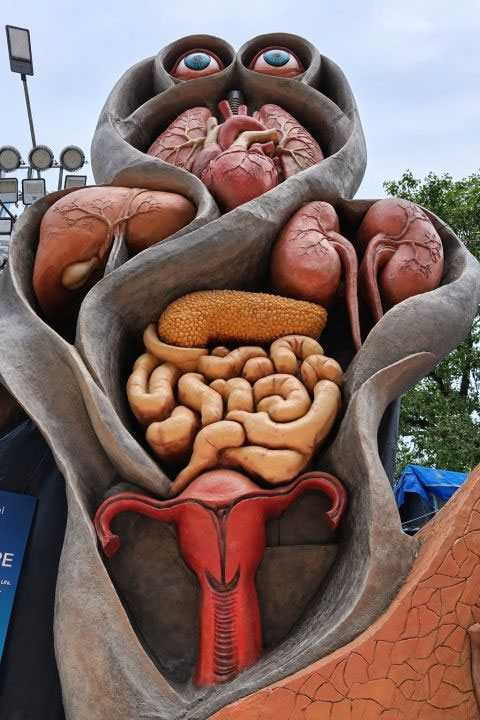
This Ganeshotsav, among the lakhs of devotees at Lalbaugcha Raja, stood something no one expected to see at a pandal: a 15.59-metre fibreglass sculpture of human organs — eyes, lungs, heart, liver, kidneys, pancreas, intestines — rising above the crowd.
Called "Organs of Hope", it was created by Gleneagles Hospital, Parel, to bring the conversation about organ donation out of hospitals and into the community. It has since earned a Guinness World Records title as the largest fibreglass sculpture of organs. You can read the news coverage here.
Standing beneath it, I found myself looking at one organ in particular — the liver. As part of the pediatric liver transplant team at Gleneagles, I see what that organ means to the children and families we care for.
The record will be remembered. But the reason behind it is simpler: some children can't wait long for a second chance.
Most children with liver problems never need a transplant. Many conditions are treatable with medicines, nutrition, or timely surgery.
But for some children, the liver fails — gradually over months, or suddenly over days. When that happens, a liver transplant can be the treatment that offers a future.
The common reasons children need a liver transplant include:
In India, many children who need a liver transplant receive part of a parent's liver. This is called living donor liver transplantation, and it has given countless children a new start.
But a living donor is not always possible. A parent may have a different blood group, a health problem of their own, or a liver that isn't suitable. And in acute liver failure, events move quickly — sometimes faster than a family can be fully evaluated as donors.
For these children, a liver from a deceased donor — someone who has been declared brain-stem dead and whose family has chosen to donate — may be the only option.
That is where every family that says "yes" to organ donation makes a difference.
The liver has a remarkable property: it can be divided.
In a split liver transplant, a liver from a suitable deceased donor is surgically divided into two parts. The smaller part can be transplanted into a child, and the larger part into an adult. Both parts can grow and function.
This matters enormously for children. Small children need small grafts, and whole livers of the right size from young donors are rare. Splitting allows a single act of generosity to help two families at once.
Not every donated liver can be split — it depends on the donor's health and liver quality, and the decision rests with the transplant team. But the more donations there are, the more often this becomes possible.
"My pledge decides everything."
In India, the family's consent is required at the time of donation. A pledge records your wish — but your family carries it forward. That is why talking to them matters more than the pledge itself.
"I'm too old, or I have a medical condition."
Very few conditions rule out donation completely. Doctors assess suitability at the time. Don't rule yourself out.
You can register your wish to donate on the official national registry run by NOTTO (National Organ and Tissue Transplant Organisation):
It takes a few minutes. But the most important step comes after:
Most children will never need a transplant — and early care is often what keeps it that way. If you're a parent, here is what to watch for:
| Tier | What you notice | What to do |
|---|---|---|
| Note it | Yellow eyes or skin in a newborn beyond 2 weeks of age | Check with your pediatrician |
| See a specialist soon | Pale, white, or clay-coloured stools at any age | Don't wait — ask for a pediatric liver evaluation within days |
| Same day | Jaundice with unusual drowsiness, bleeding, or a swollen tummy | Go to the hospital today |
Yes. Through split liver transplantation, part of an adult donor's liver can be transplanted into a child.
Many do, usually from a parent. But a deceased donor liver is essential when a living donor isn't possible or time is short.
No. It records your wish. Your family's consent is required at the time of donation, so discussing it with them is essential.
On the official NOTTO portal: notto.abdm.gov.in.
A sculpture made thousands of people stop and look up this Ganeshotsav. What happens next depends on the conversations that follow — at home, among families, between friends.
For the children I care for, that conversation can mean everything.
Dr. Anil Tambe
Pediatric Gastroenterologist & Hepatologist in Mumbai, practising at Gleneagles Hospital, Parel, where he is part of the pediatric liver transplant team. His work focuses on liver disease in children, including biliary atresia, acute liver failure, and care before and after liver transplantation.
📍 📞 🌐 Gleneagles Hospital, Parel, Mumbai | 9372530358 | pediatricgicare.com
Medical disclaimer: This article is for general awareness and education only and does not replace individual medical advice. Please consult a qualified doctor for concerns about your child's health.